A phone without internet: your child can still talk to an AI
A phone without internet can’t open apps, but it can make calls. So an AI that you reach on a phone number can answer a child who has a keypad phone, a touchscreen phone with no internet such as The Phone, or a watch that makes calls. There’s nothing to install: you save the number in their contacts, and your child calls. This guide explains how it works in France, what to check on your child’s phone, and the limits.
Why so many children in France have no internet in their pocket
In France, children most often get their first phone at 10 or 11, when they start secondary school. For parents, the main reason is simple: so their child can let them know if something goes wrong. That was the answer of 64% of the parents surveyed in 2025 by the CNIL (opens in a new tab), France’s data protection authority.
In 2024, the “Enfants et écrans” (Children and screens) commission (opens in a new tab), a panel of experts appointed by the French President, recommended a phone without internet from age 11, then internet access from 13, without social media. Families who follow this advice give their child a phone for calls and texts, and nothing else.
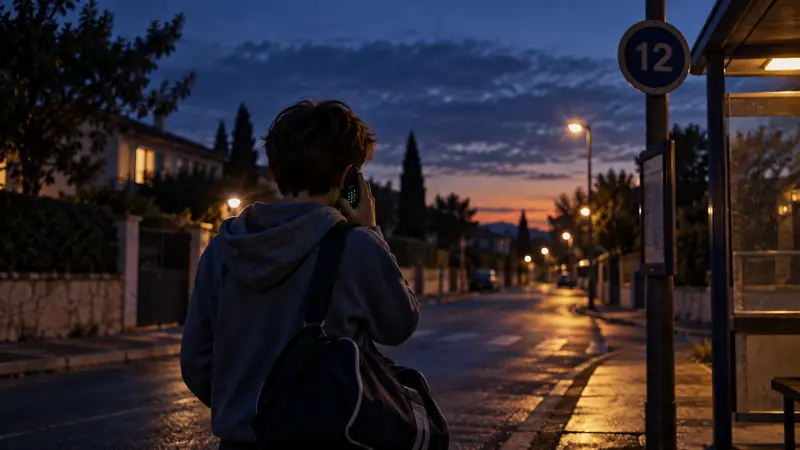
You soon notice what’s missing. The bus missed after football practice. Rain on the way, or not. The English word that won’t come back just before an oral test. On a smartphone, each of these questions goes through an app. On a phone without internet, you can still call.
An AI you call like a contact
The idea: put the AI on the end of a phone number. Your child saves it in their contacts. They call, ask their question out loud and hear the answer. They can add detail, follow up, move on to another question. Then they hang up. Nothing stays open on the phone.
Your child needs signal to make a call, not a data plan. It’s an ordinary call to a French landline number: it counts towards their plan like any other call to a landline. If their plan limits minutes, check what it includes.
This is how Folonia works, a French service in preparation: an artificial intelligence assistant, Oscar, that you reach with a phone call, from any phone, with no app and no internet. The child calls; the parent sets it up. Oscar is an AI, and it says so.
With The Phone, a French phone for children
If your child has The Phone, a touchscreen phone for children and teenagers made by a French company, you already know how it works: it makes calls, it sends texts, and that’s all. No browser, no social media, nothing to install: that’s what its maker promises (opens in a new tab). The Géo version can also show you your child’s location when you ask for it.
For Oscar, you do what you did for the grandparents’ number: you add it to the contacts (opens in a new tab), your child taps it, it rings, Oscar answers. This phone has no voice assistant: you don’t tell it “call Oscar”, you open the contacts. The wired earphones in the box are for walking, with the phone in a pocket. On a bike, French road law bans them.
With a watch or a keypad phone
A children’s watch only calls the numbers you have allowed from the parent app; other numbers don’t go through. That’s the case for the Xplora XGO3 (opens in a new tab) and the Kids Watch from Bouygues Telecom (opens in a new tab), a French mobile operator (the watch itself is made by TCL): two common models in France. For your child to reach Oscar, add the number to that list. These watches also have a school mode, which blocks calls in class. We haven’t tested a watch yet.
A keypad phone calls any number. Just check that it can still make calls. Operators are switching off 2G in mainland France this autumn: Orange in October 2026 (opens in a new tab), SFR and Bouygues Telecom by mid-December (opens in a new tab). A phone that only calls over 2G will no longer make calls. If you’re buying one, choose a model that calls over 4G, a feature called VoLTE, shown on the spec sheet. At HMD (opens in a new tab), the company behind Nokia-branded phones, every keypad phone it sells in France today is 4G; the 2660 Flip (opens in a new tab), a flip phone with big keys, is one of them. Its maker presents it as a phone for calls, texts and photos, and little else.
Whatever the device, your child’s number must not be withheld (caller ID must be on): that’s how Oscar recognises their profile and your settings.
What your child can ask
Folonia Junior is designed for useful everyday questions. A few examples, translated from French:
- “Which bus do I take to get home?”
- “Will it rain when I come out of football?”
- “Explain Pythagoras simply, I’ve got a test tomorrow.”
- “How do you say ‘j’ai oublié mes affaires’ in English?”
From your account, you choose what they can do and for how long. You switch tools on one by one: weather, bus and train journeys, homework help. Your child has no browser, no social media and no open internet search. Nothing to install, no account in their name.
With homework, Oscar explains and gets them thinking; it doesn’t do the work for them. It doesn’t present itself as a friend and never promises to keep secrets. You don’t read their conversations, and that’s deliberate: a child who’s watched at every word stops calling.
The limits, to tell your child
- It isn’t an emergency service. In an emergency, call 112.
- An AI can make mistakes. For anything important, check with an adult.
- Not in class. In France, phones have had to be switched off and put away in every collège (ages 11 to 15) since September 2025 (opens in a new tab), watches included, and in every lycée (ages 15 to 18) since September 2026 (opens in a new tab). Oscar is for before and after school, evenings and weekends.
- Oscar doesn’t know where your child is. A call doesn’t share their location. They say where they are, or “home” if you’ve saved it.
Where Folonia stands
Folonia isn’t open yet, and no date has been announced. It will open first in France: Oscar is reached on a French landline number, and accounts are set up with a French mobile number. Oscar speaks French: the service is designed and tested in French, and we don’t promise conversations in other languages. Settings for children aged 10 to 14 may come later than the rest of the service. We can’t yet say when Folonia will reach other countries.
To hear when it opens, join the waiting list: just one message, by email or text.
Frequently asked questions
Does my child need a smartphone or a data plan?
No. To call Oscar, Folonia’s assistant, any phone that makes calls will do: a keypad phone, a phone without internet, a watch that makes calls, or even a landline. You only need signal to make a call.
How much does the call cost?
From France, a call to Oscar costs the price of a normal call to a French landline number, usually included in phone plans. From another country, it’s a call to a French number, charged at your provider’s rates. The parent pays for the Folonia subscription: the Family plan, at a planned launch price in France of €14.99 a month including VAT, for up to five people, with no commitment.
Could my child come across anything inappropriate?
With Folonia Junior, your child has no browser, no social media and no open internet search. You switch tools on one by one. Oscar doesn’t pretend to be a friend, never promises to keep secrets and, in a serious situation, gives your child the right helpline numbers.
Will I be able to read their conversations?
No, and that’s deliberate. You choose what your child can do and for how long; you don’t read what they say.
Does it work with their watch?
The watch must be able to call a French landline number, and you need to add the number to its allowed contacts. We haven’t tested a watch yet: the list of tested models will be published here.
What age is it for?
Folonia Junior is for ages 10 to 17, and the parent sets it up. Settings for children aged 10 to 14 may come later than the rest of the service.
Is Folonia available outside France?
No. Folonia isn’t open anywhere yet, not even in France. It will open first in France, with a French phone number, and we can’t yet say when it will reach other countries. The waiting list is open wherever you live.